
Tiny Countries With Big Stories can be some of the most fascinating places to explore because their small size often hides centuries of history, unusual traditions, dramatic political changes, and remarkable cultural achievements. A country does not need a huge population or a large territory to have a story worth discovering. From ancient kingdoms and medieval trading centers to modern states shaped by geography and resilience, these nations show how much history can exist within a surprisingly small space.
This article explores nine that offer something different from the usual travel destinations. Their stories include ancient heritage, distinctive cultures, strategic locations, royal traditions, migration, independence, and unique relationships with the surrounding world.
Table of Contents
- Why Tiny Countries With Big Stories Matter
- Tiny Countries With Big Stories: Vatican City
- Tiny Countries With Big Stories: San Marino
- Tiny Countries With Big Stories: Monaco
- Tiny Countries With Big Stories: Liechtenstein
- Tiny Countries With Big Stories: Andorra
- Tiny Countries With Big Stories: Malta
- Tiny Countries With Big Stories: Bhutan
- Tiny Countries With Big Stories: Brunei
- Tiny Countries With Big Stories: The Marshall Islands
- What Tiny Countries With Big Stories Teach Us
- Conclusion
Why Tiny Countries With Big Stories Matter
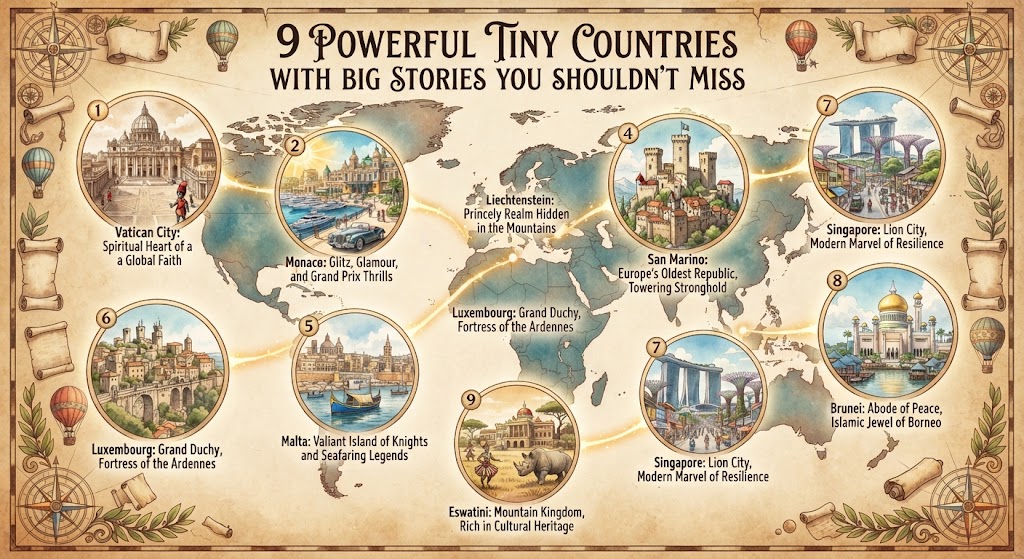
The idea behind is simple: physical size does not determine historical importance. Some of the world’s smallest countries have played important roles in religion, trade, diplomacy, warfare, finance, or cultural exchange.
Small countries can also preserve traditions that might disappear elsewhere. Their limited geographic area sometimes creates strong local identities, while their location can place them at the crossroads of larger civilizations. This makes them particularly interesting for readers who want to discover lesser-known history without focusing only on the world’s largest nations.
Tiny Countries With Big Stories: Vatican City
Among the most remarkable is Vatican City. Located within Rome, Vatican City is the world’s smallest independent state by area and is the spiritual center of the Roman Catholic Church.
Its modern status developed through the Lateran Treaty of 1929, which established Vatican City as an independent state. Despite its extremely small territory, it has enormous cultural and religious importance.
Tiny Countries With Big Stories and Vatican Heritage
Vatican City contains famous artistic and architectural treasures, including St. Peter’s Basilica and the Sistine Chapel. Its museums preserve paintings, sculptures, manuscripts, and other works collected across centuries.
The country demonstrates how a very small geographical area can hold an extraordinary concentration of history, art, religion, and architecture.
Tiny Countries With Big Stories: San Marino
San Marino is another fascinating example of Tiny Countries With Big Stories. Surrounded by Italy, this small republic has a long political history and traditionally traces its foundation to Saint Marinus.
San Marino is particularly interesting because it has maintained its independent identity through many periods of European political change. Its location inside the Italian Peninsula meant that larger political powers surrounded it, yet the republic continued to preserve its separate institutions.
Tiny Countries With Big Stories and Ancient Independence
The historic center of San Marino and Mount Titano are recognized by UNESCO as a World Heritage site. The landscape combines fortifications, historic buildings, and dramatic mountain views.
Its story shows how geography, institutions, and cultural identity can contribute to the survival of a small state over a very long period.
Tiny Countries With Big Stories: Monaco
Monaco provides a very different example of Tiny Countries With Big Stories. Located on the Mediterranean coast, Monaco is closely associated with the Grimaldi family, whose history has shaped the principality for centuries.
The country is known internationally for its coastal setting, royal traditions, luxury tourism, and major events. Yet beneath its modern image is a complex history involving European politics, territorial relationships, and economic transformation.
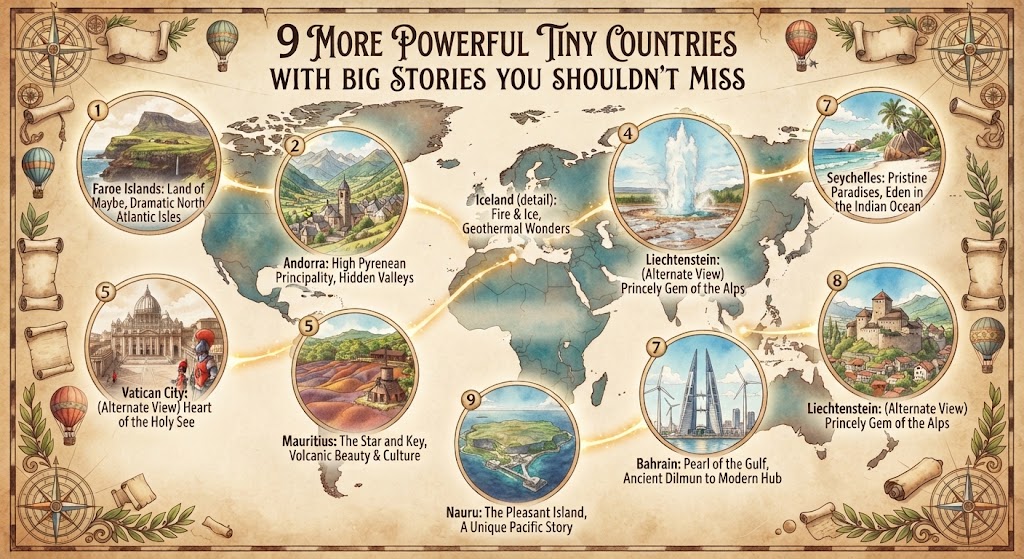
Tiny Countries With Big Stories and Monaco’s Transformation
Monaco’s development demonstrates how geography can influence a nation’s economic direction. Its position on the Mediterranean helped it become a destination for international visitors and contributed to its modern reputation.
The story of Monaco is therefore not only about wealth or tourism. It is also about how a small territory developed a distinctive political and economic identity within Europe.
Tiny Countries With Big Stories: Liechtenstein
Liechtenstein is one of Europe’s smallest countries and an important example of Tiny Countries With Big Stories. Located between Switzerland and Austria, it has a history connected with the Holy Roman Empire and the development of European princely states.
The country became a sovereign member of the Confederation of the Rhine in the early nineteenth century and later developed its modern political structure.
Tiny Countries With Big Stories and Mountain Identity
Liechtenstein’s Alpine landscape has strongly influenced its cultural identity. Mountains, valleys, castles, and small communities give the country a distinctive character.
Vaduz Castle, associated with the princely family, is one of its best-known landmarks. The combination of European political history and Alpine culture makes Liechtenstein especially interesting for people exploring lesser-known European countries.
Tiny Countries With Big Stories: Andorra
Andorra is a small mountainous country located between France and Spain in the Pyrenees. Its unusual political history makes it one of the most interesting Tiny Countries With Big Stories.
Andorra developed a distinctive co-principality system involving the Bishop of Urgell and the French head of state. This unusual arrangement has roots reaching back to medieval agreements.
Tiny Countries With Big Stories and Mountain Traditions
For centuries, Andorra’s mountainous geography helped shape its communities and traditions. Modern tourism later became a major part of its economy, particularly through skiing and mountain travel.
Andorra’s transformation from an isolated mountain society into a modern European destination illustrates how geography can influence both history and economic development.
Tiny Countries With Big Stories: Malta
Malta has a surprisingly large historical story considering its small size. Positioned in the central Mediterranean, Malta has been influenced by numerous civilizations, making it one of the richest examples of Tiny Countries With Big Stories.
Phoenicians, Romans, Arabs, Normans, the Knights of St. John, the French, and the British all played roles in Malta’s long history.
Tiny Countries With Big Stories and Mediterranean History
Malta’s strategic location made it important for maritime travel and military activity. Its fortified cities and historic buildings still reflect different periods of Mediterranean history.
The country’s megalithic temples are especially important because some are among the world’s oldest free-standing stone structures. Malta therefore connects prehistoric heritage with later European and Mediterranean history.
Tiny Countries With Big Stories: Bhutan
Bhutan offers a completely different story among Tiny Countries With Big Stories. Located in the eastern Himalayas, Bhutan developed a distinctive cultural and political identity influenced by Himalayan Buddhism.
The country is known for its monasteries, mountain landscapes, traditional architecture, and strong cultural preservation.
Tiny Countries With Big Stories and Cultural Preservation
Bhutan’s approach to development has attracted international attention because it has emphasized ideas such as Gross National Happiness alongside conventional economic measures.
Its history and geography have helped preserve traditions that remain visible in architecture, clothing, festivals, and religious practices. Bhutan demonstrates that a small country can maintain a highly distinctive identity while participating in the modern global economy.
Tiny Countries With Big Stories: Brunei
Brunei is a small country on the island of Borneo and another compelling example of Tiny Countries With Big Stories. Its history is connected with the powerful Bruneian Sultanate, which once exercised significant influence in parts of Borneo and surrounding regions.
The country’s modern development has also been strongly connected with petroleum and natural gas resources.
Tiny Countries With Big Stories and Royal Heritage
Brunei’s monarchy remains an important part of its national identity. The country’s historical traditions, Islamic heritage, royal institutions, and modern energy economy create a distinctive combination.
Brunei demonstrates that a small state can have a regional historical influence that extends far beyond its current geographic boundaries.
Tiny Countries With Big Stories: The Marshall Islands
The Marshall Islands provide one of the most powerful examples of Tiny Countries With Big Stories outside Europe. Located in the central Pacific, this island nation consists of many atolls and islands spread across a large area of ocean.
Its history includes traditional Micronesian societies, European exploration, colonial administration, and the complex geopolitical events of the twentieth century.
Tiny Countries With Big Stories and Pacific Heritage
The Marshall Islands became independent in association with the United States through a Compact of Free Association. Its modern history is also connected with nuclear testing conducted by the United States in the mid-twentieth century.
Today, the country faces significant environmental and geographic challenges associated with its low-lying islands. Its story highlights the importance of ocean geography, cultural heritage, international relationships, and environmental change.
Tiny Countries With Big Stories: A Historical Comparison
The nine countries discussed above differ greatly in geography, culture, and historical development. Their stories demonstrate that there is no single definition of what makes a small country historically important.
| Country | Region | Major Story Theme | Distinctive Feature |
|---|---|---|---|
| Vatican City | Europe | Religious history | Global religious importance |
| San Marino | Europe | Long independence | Historic republican identity |
| Monaco | Europe | Political and economic transformation | Mediterranean location |
| Liechtenstein | Europe | Princely history | Alpine identity |
| Andorra | Europe | Medieval political development | Pyrenean culture |
| Malta | Europe | Mediterranean civilizations | Ancient heritage |
| Bhutan | Asia | Cultural preservation | Himalayan traditions |
| Brunei | Asia | Sultanate history | Royal and energy heritage |
| Marshall Islands | Pacific | Colonial and geopolitical history | Atoll geography |
This comparison shows why Tiny Countries With Big Stories deserve attention. Each country has developed a different relationship with geography, culture, politics, and history.
Tiny Countries With Big Stories: Story Diversity
The chart below is an illustrative classification of the dominant historical themes discussed in this article, not a measurement of each country’s overall history.
The comparison highlights the variety found among Tiny Countries With Big Stories. Cultural heritage and political history appear repeatedly, while geography often explains why these countries developed distinctive identities.
What Tiny Countries With Big Stories Teach Us
One important lesson from Tiny Countries With Big Stories is that size does not determine cultural depth. A small country can preserve languages, traditions, architecture, political institutions, and historical memories that have survived for generations.
Another lesson is the importance of geography. Mountain ranges helped shape Andorra and Liechtenstein, while the Mediterranean influenced Malta and Monaco. Ocean geography has played an especially important role in the Marshall Islands.
These examples also show how countries can adapt to changing circumstances. Some developed around tourism, some around natural resources, and others around cultural or religious institutions. Their histories are different, but each demonstrates how societies respond to the opportunities and limitations of their surroundings.
Why Tiny Countries With Big Stories Are Worth Exploring
Tiny Countries With Big Stories are worth exploring because they challenge the assumption that famous history only comes from large empires and major powers. Their stories can reveal different perspectives on independence, identity, tradition, geography, and modernization.
For people interested in travel research, cultural history, or unusual destinations, these countries offer a useful starting point. They also provide examples of how communities can maintain a distinctive identity despite living in a highly interconnected world.
Conclusion
The world is filled with places that appear small on a map but contain remarkably rich histories. Tiny Countries With Big Stories such as Vatican City, San Marino, Monaco, Liechtenstein, Andorra, Malta, Bhutan, Brunei, and the Marshall Islands demonstrate how culture, geography, political institutions, and historical events can create stories far larger than a country’s physical size.
Exploring these nations encourages us to look beyond population and territory when thinking about historical importance. Their stories remind us that even the smallest countries can preserve extraordinary traditions, influence regional history, and offer lessons about identity and adaptation.

Leave a Reply