
Rare Foods Around the World offer a fascinating look at how different communities have developed unique eating traditions over generations. While many foods are now available internationally, countless traditional dishes remain strongly connected to particular regions, seasons, local ingredients, and cultural practices. Some foods may seem unusual to outsiders, yet they can hold deep historical and cultural meaning for the people who prepare them.
From fermented delicacies and unusual fruits to traditional animal-based dishes and ingredients found only in specific environments, rare foods can tell stories that ordinary menus often cannot. Their ingredients may reflect local geography, while their preparation methods can preserve techniques passed from parents to children.
Exploring Rare Foods Around the World is therefore not simply about finding strange things to eat. It is about understanding why communities value particular ingredients and how food connects people with history, environment, celebrations, and identity. In this article, we explore seven fascinating examples while looking at the traditions and stories behind them.
Table of Contents
- Rare Foods Around the World and Cultural Traditions
- Rare Foods Around the World From Japan
- Rare Foods Around the World From Iceland
- Rare Foods Around the World From Southeast Asia
- Rare Foods Around the World From South America
- Rare Foods Around the World and Unusual Fruits
- Rare Foods Around the World and Fermentation
- Why Rare Foods Around the World Matter
- Conclusion
Rare Foods Around the World and Cultural Traditions
Rare Foods Around the World often develop because communities learn to use whatever resources are available in their environment. Before modern transportation and refrigeration, people depended heavily on seasonal ingredients and preservation techniques.
This encouraged communities to develop methods such as drying, fermenting, smoking, salting, pickling, and curing. These techniques allowed food to survive longer while also creating distinctive flavors.
Over time, practical food-preservation methods often became cultural traditions. A dish that originally helped people survive difficult seasons could eventually become an important part of celebrations, family gatherings, or regional identity.
Rare Foods Around the World Reflect Local Environments
Geography plays an important role in food traditions. Coastal communities often developed dishes based on seafood, while mountain regions relied heavily on dairy, grains, preserved foods, or locally available plants.
Climate also influences what can grow and how food is stored. In colder regions, preservation can be essential during long winters. In tropical regions, fermentation and drying can help manage highly perishable ingredients.
This relationship between environment and cuisine makes Rare Foods Around the World especially interesting because every unusual food has a story connected to its surroundings.
Rare Foods Around the World From Japan
Rare Foods Around the World include several distinctive Japanese ingredients and traditional foods that are unfamiliar to many international diners. Japan has a long culinary history shaped by coastal geography, seasonal ingredients, fermentation, and careful preparation.
One example is natto, a traditional food made by fermenting soybeans. Its strong aroma and sticky texture can surprise people who have never tried it, but it has a long history in Japanese cuisine.
Another distinctive ingredient is fugu, a type of pufferfish that requires specialized preparation because some parts of certain pufferfish species can contain dangerous toxins. Proper preparation is therefore an important part of the tradition surrounding this food.
Rare Foods Around the World Show the Importance of Preparation
Foods such as these demonstrate that unusual cuisine is not simply about ingredients. Preparation can be equally important.
Traditional culinary knowledge can involve selecting particular parts of an ingredient, controlling fermentation, removing unwanted components, or using specific cooking techniques.
This knowledge is often passed through generations and can become an important part of culinary heritage.
Rare Foods Around the World From Iceland
Rare Foods Around the World also include traditional Icelandic foods shaped by a cold climate and a history of preserving food for difficult seasons.
Hákarl, or fermented shark, is one of Iceland’s most famous traditional foods. It is prepared through a lengthy curing and fermentation process. Its strong smell and distinctive taste make it an unusual experience for many visitors.
The history behind such food is important because preservation was once essential in environments where fresh ingredients could be limited during certain periods.
Rare Foods Around the World Preserve Old Techniques
Traditional preservation methods provide a connection between modern cuisine and earlier generations.
Although modern refrigeration and global food transportation have changed how people eat, some traditional foods remain part of cultural celebrations and regional identity.
This demonstrates how an old survival technique can become a cultural symbol long after the original necessity has changed.
Rare Foods Around the World From Southeast Asia
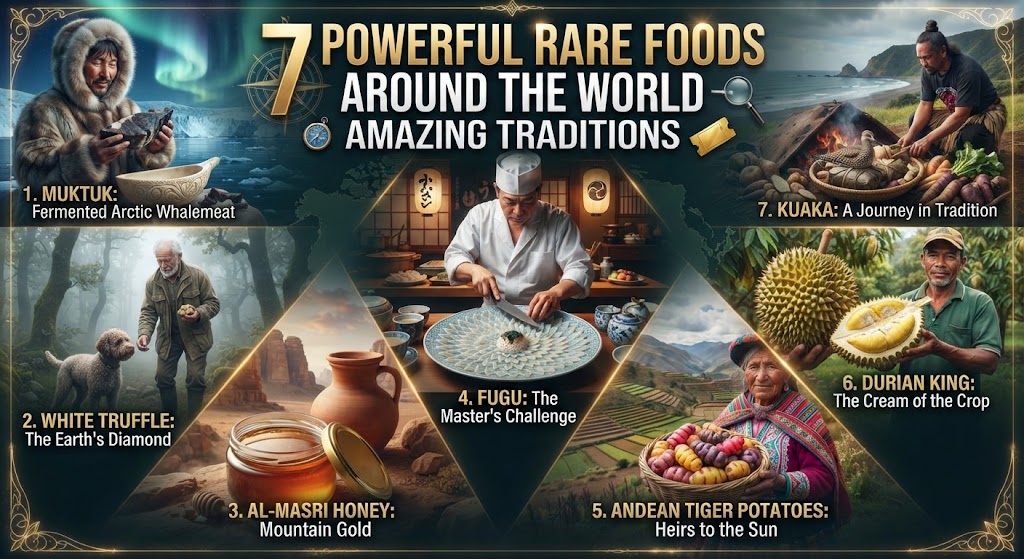
Rare Foods Around the World are particularly diverse across Southeast Asia, where tropical climates provide a huge variety of fruits, plants, seafood, spices, and fermented ingredients.
Durian is perhaps one of the best-known examples. It has a powerful aroma that divides opinion, but it is highly valued in several Southeast Asian cuisines.
Other regional foods include fermented fish products, unusual herbs, preserved fruits, and ingredients that may be difficult to find outside their original regions.
Rare Foods Around the World Can Have Strong Aromas
Strong aromas are a common feature of several traditional foods. Fermentation can create powerful smells because microorganisms transform ingredients during the preservation process.
For people unfamiliar with these foods, the aroma may seem surprising. For communities with a long history of eating them, however, the smell can be associated with familiar dishes, family meals, and cultural traditions.
Rare Foods Around the World From South America
Rare Foods Around the World also include unusual ingredients found in South American ecosystems. The continent contains enormous biological diversity, and many traditional cuisines make use of native plants, fruits, grains, roots, and other local ingredients.
Some traditional foods that appear unusual elsewhere have been important sources of nutrition for local communities for generations.
For example, certain Amazonian fruits and plant-based ingredients have become increasingly interesting to international food researchers because of their unique flavors and nutritional characteristics.
Rare Foods Around the World Connect People With Native Plants
Traditional knowledge about plants can be highly valuable. Indigenous and local communities have developed detailed knowledge about which plants are edible, how they should be prepared, and when they should be harvested.
However, not every wild plant is safe to eat. Traditional foods should therefore be understood within their cultural and environmental context rather than copied without appropriate knowledge.
Rare Foods Around the World and Unusual Fruits
Rare Foods Around the World would not be complete without unusual fruits. Tropical and subtropical regions contain fruits that may be common locally but almost unknown internationally.
Rambutan, mangosteen, salak, and other tropical fruits demonstrate how different climates can produce flavors and textures that are unfamiliar to people from other regions.
Some fruits have spiky skins, unusual colors, strong aromas, or textures that make them memorable.
Rare Foods Around the World Offer New Flavor Experiences
The appeal of unusual fruits comes partly from their combination of appearance, aroma, texture, and taste.
Modern international food markets have made some formerly rare fruits easier to find, but availability still depends heavily on climate, transportation, cultivation, and demand.
This means many regional fruits remain relatively uncommon outside their traditional growing areas.
Rare Foods Around the World and Fermentation
Rare Foods Around the World frequently involve fermentation because it is one of humanity’s oldest methods of transforming and preserving food.
Fermentation uses microorganisms such as bacteria or yeast to change the chemical characteristics of food. Depending on the ingredients and process, fermentation can alter taste, smell, texture, acidity, and shelf life.
Foods such as fermented vegetables, dairy products, grains, beans, fish, and meats appear in traditional cuisines across many continents.
Rare Foods Around the World Reveal Ancient Food Science
Fermentation demonstrates that traditional communities developed sophisticated food-processing techniques long before modern microbiology existed.
People learned through generations of observation that certain conditions could transform ingredients into foods with different flavors and storage properties.
Modern science can now explain many of the biological processes involved, but the traditional knowledge behind these foods remains culturally significant.
Rare Foods Around the World: Quick Comparison
| Food or Ingredient | Region Associated With | Distinctive Feature | Traditional Connection |
|---|---|---|---|
| Natto | Japan | Fermented soybeans | Traditional Japanese cuisine |
| Fugu | Japan | Specialized preparation | Long-standing culinary tradition |
| Hákarl | Iceland | Fermented shark | Historical preservation |
| Durian | Southeast Asia | Strong aroma | Regional fruit culture |
| Rambutan | Southeast Asia | Hairy outer skin | Tropical cuisine |
| Salak | Southeast Asia | Scaly skin | Regional fruit traditions |
| Amazonian fruits | South America | Diverse native varieties | Local and Indigenous food knowledge |
Availability and traditional use can vary by region.
Rare Foods Around the World and Their Cultural Value
Rare Foods Around the World are valuable because food can preserve cultural memories. A recipe may carry information about climate, migration, agriculture, trade, family traditions, and historical challenges.
A traditional dish can also bring generations together. Older family members may teach younger people how to prepare it, ensuring that techniques survive even when lifestyles change.
In this way, food can function as a living form of cultural heritage.
Rare Foods Around the World Can Protect Culinary Heritage
Globalization creates both opportunities and challenges for traditional foods. International interest can introduce regional ingredients to new audiences, but commercial demand can also change traditional production methods.
Preserving culinary heritage requires more than simply selling unusual foods. It involves respecting the communities, knowledge, environments, and traditions connected with them.
Why Rare Foods Around the World Matter
Rare Foods Around the World help us understand that there is no single definition of what makes food normal or unusual. A dish that seems strange to one person may be an everyday meal for another community.
Food traditions are shaped by history and geography. What people eat often reflects what grows nearby, what can be preserved, what animals are available, and what cultural practices have survived through generations.
Exploring these foods with curiosity rather than judgment can make international cuisine much more interesting.
Rare Foods Around the World Encourage Food Discovery
Trying unfamiliar foods can introduce people to new ingredients and preparation methods. It can also encourage travelers and food enthusiasts to learn more about the history behind a dish instead of focusing only on whether it looks unusual.
The most interesting part of a rare food is often the story surrounding it.
Conclusion
Rare Foods Around the World provide a fascinating window into human creativity, survival, culture, and tradition. From fermented foods in cold climates to unusual tropical fruits and carefully prepared regional delicacies, these foods demonstrate how communities have adapted their diets to their environments.
What may appear unusual at first can have centuries of history behind it. Traditional ingredients often carry knowledge about preservation, agriculture, local ecosystems, and family customs.
As international food culture continues to grow, many previously unfamiliar foods are becoming easier to discover. Yet their real value goes beyond novelty. Rare Foods Around the World remind us that every cuisine has its own history, and sometimes the most surprising foods have the most interesting stories.

Leave a Reply