
In a rapidly changing world, Traditional Crafts Slowly Disappearing has become an important cultural concern. Many handmade skills that once passed naturally from one generation to another are now facing challenges from mass production, modern lifestyles, changing consumer habits, and a shortage of young artisans. These crafts carry more than artistic value because they preserve stories, cultural identity, local materials, and techniques developed over hundreds of years.
From handmade pottery and traditional weaving to wood carving, metalworking, embroidery, basket making, and natural dyeing, countless skills continue to depend on experienced craftspeople. When fewer people learn these techniques, the knowledge behind the finished products can gradually disappear. Understanding Traditional Crafts Slowly Disappearing can help communities recognize the value of these skills and explore practical ways to keep them alive for future generations.
In this article, we explore 9 remarkable traditional crafts that are slowly declining, why they are at risk, and how modern communities can help preserve their unique knowledge and cultural importance.
Table of Contents
- Why Traditional Crafts Slowly Disappearing Matters
- Handmade Pottery
- Traditional Weaving
- Hand-Carved Wooden Craft
- Traditional Metalworking
- Basket and Mat Making
- Handmade Paper and Bookbinding
- Traditional Dyeing and Embroidery
- How Communities Can Protect Traditional Crafts
- The Future of Traditional Crafts Slowly Disappearing
Why Traditional Crafts Slowly Disappearing Matters
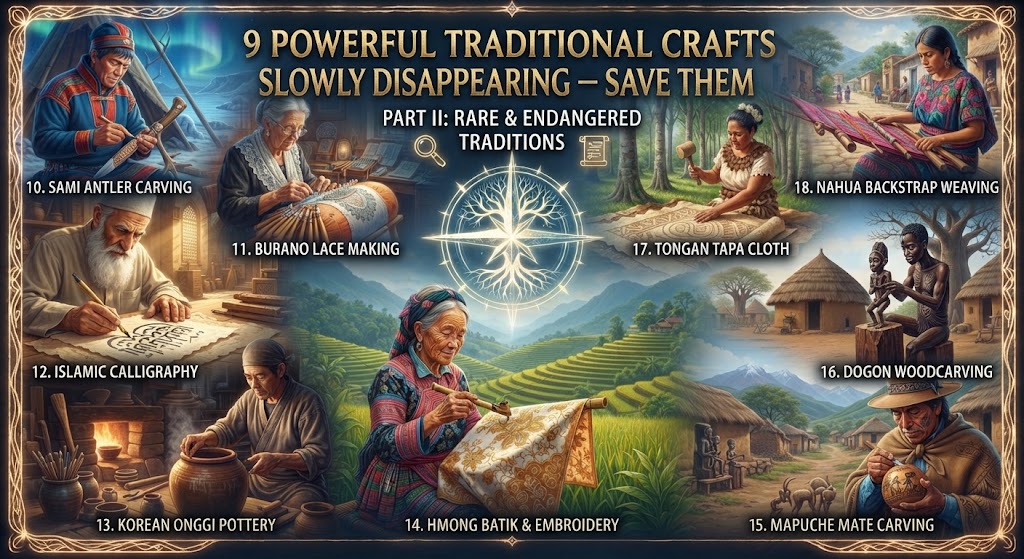
The story of Traditional Crafts Slowly Disappearing is closely connected with cultural memory. A handmade object can tell us how people lived, what materials were available in a region, and what designs were considered meaningful. Traditional crafts can also reflect local environments because craftspeople often use materials that naturally occur around their communities.
When a technique disappears, replacing the finished object is not enough. A factory may reproduce a similar appearance, but it cannot automatically reproduce the complete knowledge behind the original process. The lost knowledge may include how to prepare materials, recognize quality, control temperature, mix natural dyes, shape objects by hand, or create patterns from memory.
Traditional crafts can also support local economies when artisans have access to fair markets. Craft tourism, online marketplaces, cultural festivals, museums, and educational programs can create new opportunities for skilled makers while helping younger people see traditional work as valuable knowledge rather than an outdated occupation.
Traditional Crafts Slowly Disappearing Around the World
Traditional Crafts Slowly Disappearing can be observed across many different categories, from textiles and pottery to woodworking, metalworking, paper production, basketry, embroidery, and natural dyeing. The situation differs greatly from one region to another, so it is difficult to describe every traditional craft as disappearing at the same speed.
Some crafts have already experienced major declines but are being revived through cultural organizations and artisan communities. Others continue to have active practitioners but face challenges such as rising material costs and limited access to younger apprentices.
These examples show how different types of traditional knowledge can be affected by modernization.
Traditional Crafts Slowly Disappearing and Handmade Pottery
Handmade pottery is one of the oldest forms of craft knowledge. In traditional pottery communities, artisans may know exactly how local clay behaves, how much water should be added, how a vessel should be shaped, and how firing affects the final surface.
Modern ceramic factories can produce thousands of identical items quickly. This makes handmade pottery harder to compete with on price. Younger people may also prefer occupations that provide more predictable income.
Yet handmade pottery has qualities that mass production cannot completely duplicate. Small variations in shape, texture, and color are part of the character of an individual handmade object. Protecting this knowledge means preserving more than the finished bowl, pot, or decorative piece.
Traditional Crafts Slowly Disappearing Through Weaving
Traditional weaving is another important example of Traditional Crafts Slowly Disappearing. Different communities have developed distinctive patterns, looms, fibers, and weaving methods over generations. Some designs can communicate information about regional identity, family traditions, celebrations, or historical events.
Hand weaving can require significant time and concentration. A machine can produce fabric much faster, making it difficult for individual weavers to compete with industrial textiles.
However, traditional weaving can still find a place in modern markets when customers understand the labor and cultural value behind handmade products. Contemporary designers can also work with artisans to create products that combine traditional techniques with modern uses.
Hand-Carved Wooden Craft
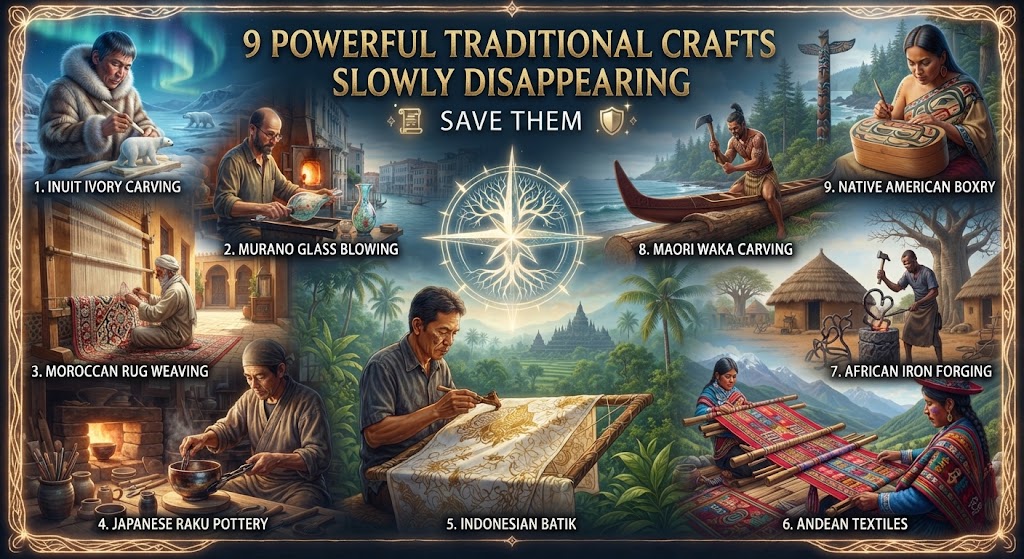
Wood carving demonstrates how traditional knowledge can depend heavily on both material and technique. Experienced carvers learn how different types of wood respond to cutting tools, how grain direction affects a design, and how to create detailed shapes without damaging the material.
Traditional Crafts Slowly Disappearing becomes particularly visible when younger generations no longer learn these skills directly from experienced craftspeople. Once a master stops working without passing on the technique, certain methods may become extremely difficult to reconstruct.
Wood carving can survive when workshops, apprenticeships, cultural centers, and local markets provide opportunities for new artisans. Digital platforms can also help craftspeople reach customers outside their immediate communities.
Traditional Metalworking Craft
Traditional metalworking includes blacksmithing, decorative metalwork, toolmaking, jewelry making, and other techniques. Before industrial manufacturing became widespread, skilled metalworkers played an important role in producing everyday objects.
Today, inexpensive factory-made tools and decorative objects have reduced the need for many traditional workshops. Some specialized techniques remain alive because customers value handmade quality, historical designs, or customized work.
The challenge is that metalworking can require expensive equipment, physical strength, training, and years of practice. This makes it particularly important to create opportunities for apprentices to learn directly from experienced artisans.
Basket and Mat Making
Basket and mat making often uses natural materials such as grasses, reeds, bamboo, palm leaves, or other locally available plants. The techniques may appear simple, but producing strong and attractive pieces can require considerable experience.
The decline of these crafts can happen when plastic and synthetic products replace traditional materials in everyday life. As demand falls, fewer people have a reason to spend time learning the techniques.
Still, modern interest in sustainable and natural products may provide new opportunities. Handmade baskets and mats can be used as home décor, storage products, furniture elements, or cultural products while maintaining traditional construction methods.
Handmade Paper and Bookbinding
Handmade paper and traditional bookbinding represent another fascinating part of Traditional Crafts Slowly Disappearing. Before modern industrial paper production, making paper was a specialized process involving natural fibers, water, pressing, drying, and careful finishing.
Traditional bookbinding similarly requires knowledge of folding, stitching, covering, and protecting pages. Digital reading and mass-produced books have changed the demand for handmade book production.
Despite these changes, handmade paper and bookbinding can remain relevant in artistic, educational, archival, and specialty applications. Workshops that teach these techniques can help preserve practical knowledge while introducing them to new audiences.
Traditional Dyeing and Embroidery
Natural dyeing and embroidery combine technical skill with visual storytelling. Traditional dyers may use plants, minerals, insects, or other natural sources to create colors. Embroiderers can spend many hours creating patterns by hand.
Synthetic dyes and machine embroidery have made clothing production faster and cheaper. As a result, some traditional techniques have become less common.
Yet these crafts can adapt without losing their identity. Artisans can use traditional patterns on modern clothing, accessories, household textiles, and decorative products. The key is ensuring that modernization does not completely remove the original technique.
A Simple View of Traditional Crafts Slowly Disappearing
The preservation of Traditional Crafts Slowly Disappearing can be understood through four connected stages: learning, practicing, earning, and passing knowledge to another generation.
The chart is a conceptual framework rather than statistical research. Each stage matters because a craft needs people who can learn the technique, practice it regularly, earn enough to continue, and teach the knowledge to another generation.
How Communities Can Protect Traditional Crafts Slowly Disappearing
Protecting Traditional Crafts Slowly Disappearing does not necessarily mean keeping every craft unchanged forever. Traditional knowledge can survive while adapting to modern lifestyles and markets.
Traditional Crafts Slowly Disappearing Need Younger Apprentices
The most direct method of preserving craft knowledge is teaching it to new people. Apprenticeships allow beginners to learn through observation and repeated practice. Books and videos can document techniques, but hands-on learning can be especially valuable for skills involving touch, pressure, temperature, timing, or material behavior.
Community workshops can make this process easier by connecting experienced artisans with students and young adults. When younger people receive practical experience, traditional knowledge has a better opportunity to continue beyond one generation.
Traditional Crafts Slowly Disappearing Can Use Digital Platforms
The internet can create new possibilities for artisans. A craftsperson who once depended entirely on local customers can potentially introduce their work to people in other regions and countries.
Short videos can demonstrate techniques, while websites can explain the cultural background behind products. This can help customers understand why a handmade object may cost more than a factory-produced alternative.
Digital storytelling can therefore become an additional preservation tool. Instead of remaining hidden inside a small community, craft knowledge can be introduced to a much wider audience.
Traditional Crafts Slowly Disappearing Can Adapt to Modern Products
Another approach is to apply traditional techniques to products that people use today. A traditional weaving method might appear in contemporary home décor. Wood carving can be incorporated into modern furniture. Handmade paper can be used for invitations, artwork, or specialty stationery.
Adaptation can create demand without requiring artisans to abandon their traditional skills. The craft can evolve while important techniques and cultural elements remain visible.
The Future of Traditional Crafts Slowly Disappearing
The future of Traditional Crafts Slowly Disappearing depends on whether cultural knowledge can remain useful in a changing world. Preservation is not only about keeping old objects inside museums. It is also about keeping the knowledge alive through people who continue to practice, teach, and develop it.
Technology can help document endangered techniques, while schools and community organizations can create learning opportunities. Online marketplaces can connect artisans with new customers, and cultural tourism can introduce visitors to local craft traditions.
At the same time, preservation should respect the communities that own and practice these traditions. A craft should not be treated only as a commercial trend. Its history, cultural meaning, and the people who maintain the knowledge are equally important.
Traditional Crafts Slowly Disappearing reminds us that cultural knowledge can disappear quietly. A technique may survive for hundreds of years and then decline within only a few generations. Supporting skilled artisans, encouraging apprenticeships, documenting techniques, and creating sustainable markets can all contribute to keeping these traditions active.
The strongest preservation happens when traditional skills remain part of everyday life rather than becoming something people only remember from the past. When a young person learns from an experienced craftsperson, practices the technique, creates something useful, and eventually teaches someone else, an important chain of knowledge continues.
That is why the story of Traditional Crafts Slowly Disappearing is not only about loss. It is also about opportunities to protect creativity, cultural memory, craftsmanship, and human knowledge before they become much harder to recover.

Leave a Reply