
Strange Weather Events can make the natural world look completely different from what we normally expect. Weather is usually associated with familiar conditions such as sunshine, rain, wind, snow, and thunderstorms, but nature can sometimes produce unusual atmospheric events that seem almost impossible. From colored rainfall and mysterious ice formations to rare lightning displays and unexpected temperature changes, these events show how complex Earth’s atmosphere can be.
Some Strange Weather Events are extremely rare, while others occur more frequently in particular regions because of local geography and atmospheric conditions. Understanding these unusual phenomena can help us appreciate the science behind them instead of treating them simply as mysterious occurrences.
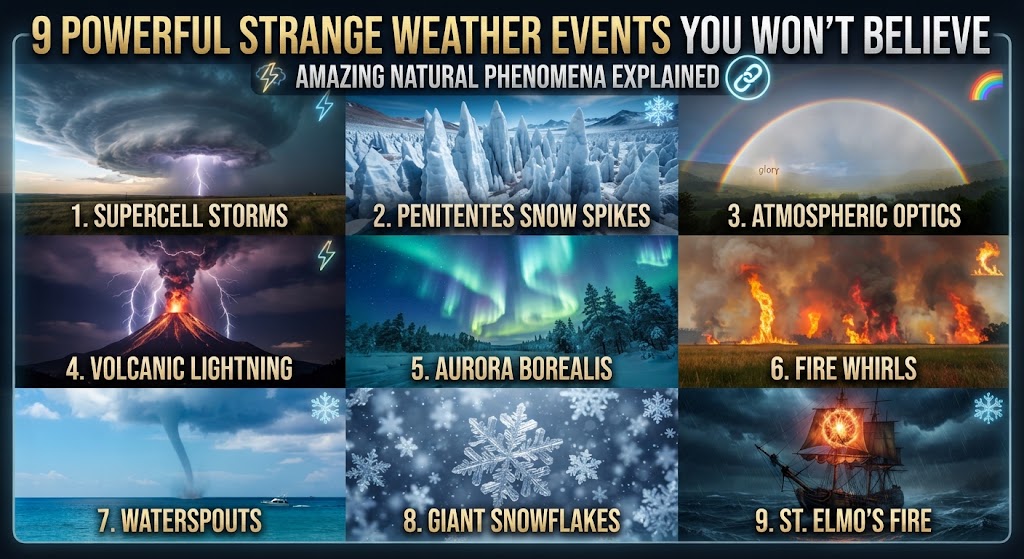
In this article, we explore nine fascinating Strange Weather Events, explain how they happen, and look at why some of them can surprise even people who have experienced many different types of weather.
Table of Contents
- Strange Weather Events and Their Science
- Blood Rain
- Ball Lightning
- Thundersnow
- Fire Whirls
- Mammatus Clouds
- Ice Storms
- Sun Dogs
- Microbursts
- Strange Weather Events and Atmospheric Rivers
- Why Strange Weather Events Matter
- The Future of Strange Weather Events
Strange Weather Events and Their Science
The atmosphere is a constantly moving system involving temperature, pressure, moisture, wind, sunlight, and countless other physical processes. When several conditions interact at the right time and location, unusual weather can develop.
This is why Strange Weather Events are not necessarily supernatural or unexplained. Many have scientific explanations, although some remain difficult to observe because they happen quickly or occur in remote locations.
The unusual appearance of an event can make it seem mysterious. However, atmospheric science provides useful explanations for many of these spectacular natural phenomena.
Blood Rain Among Strange Weather Events
One of the most visually unusual Strange Weather Events is commonly known as blood rain. The name sounds alarming, but the phenomenon does not involve actual blood.
Red or orange-colored rain can occur when atmospheric dust or other fine particles become suspended in clouds and later mix with precipitation. When the rain falls, the particles can give the water a reddish or brownish appearance.
Dust from dry regions can travel long distances through the atmosphere when strong winds lift fine particles from the ground. If those particles become incorporated into a rain-producing system, they can eventually reach the surface with rainfall.
The result can be surprising. Cars, windows, roads, and outdoor surfaces may appear to have been covered with a reddish substance after a storm.
Why Strange Weather Events Like Blood Rain Occur
The color and intensity depend on the amount and type of particles involved. A small concentration may produce only slightly tinted water, while larger amounts can create a much stronger color.
Although the appearance can be dramatic, the basic process involves atmospheric transport and precipitation rather than anything mysterious.
Ball Lightning and Strange Weather Events
Ball lightning is another fascinating example of Strange Weather Events. It is generally described as a glowing spherical or roughly spherical phenomenon associated with thunderstorms. Reports have described objects appearing for several seconds before disappearing.
Unlike ordinary lightning, which is typically seen as a bright channel or flash, ball lightning has been reported in many different shapes and sizes. Because it is difficult to observe and study directly, scientists have proposed several explanations for how it might form.
Some theories involve electrical activity, plasma, vaporized material, or interactions between lightning and surfaces. However, the exact physical mechanism behind ball lightning remains an area of scientific investigation.
The Mystery Behind Strange Weather Events
Ball lightning demonstrates why some Strange Weather Events are difficult to study. Researchers cannot easily predict when and where such a phenomenon will appear, making controlled observations challenging.
Modern cameras and scientific instruments may improve future understanding, but reliable observations remain essential for separating genuine atmospheric phenomena from visual effects, memory errors, or misidentification.
Thundersnow as Strange Weather Events
Thunder and snow are both familiar weather conditions, but experiencing them together can be surprising. Thundersnow refers to a thunderstorm occurring while snow is falling.
For this phenomenon to develop, the atmosphere needs the right combination of instability, moisture, and lifting. Strong upward motion can produce clouds capable of generating lightning and thunder even when temperatures near the ground are cold enough for snow.
During intense winter storms, people may sometimes hear thunder shortly after seeing lightning while heavy snow is falling.
The sound can seem different from thunder during a summer storm because snow can absorb and scatter sound. The surrounding landscape may therefore feel unusually quiet despite the presence of thunder.
Why Strange Weather Events Include Thundersnow
Thundersnow is a useful reminder that thunderstorms are not limited to hot summer weather. The atmosphere can produce electrical activity under winter conditions when the necessary ingredients come together.
Fire Whirls and Strange Weather Events
Fire whirls are dramatic rotating columns of heated air and flames that can develop near intense fires. They are sometimes called fire tornadoes, although not every fire whirl has the structure of a true tornado.
Strong heating near a fire causes air to rise rapidly. Under suitable wind and circulation conditions, that rising air can begin rotating. The result may be a narrow, spinning column that carries flames, smoke, ash, and hot gases upward.
Fire whirls can become dangerous because their movement may be difficult to predict. They can also increase the spread of burning material by transporting embers.
How Strange Weather Events Become Dangerous
This example shows that unusual weather-related phenomena are not always harmless spectacles. Fire whirls involve extreme heat and can occur during major wildfires, making distance and safety precautions extremely important.
Mammatus Clouds Among Strange Weather Events
Mammatus clouds are among the most visually recognizable Strange Weather Events. They appear as rounded pouch-like formations hanging beneath a cloud base, often creating a dramatic sky.
The name comes from a Latin term associated with the appearance of breasts or udders. These formations are commonly associated with strong thunderstorms, although their presence does not automatically mean that a severe storm is directly overhead.
The unusual shapes form because of complex interactions involving sinking air, moisture, temperature differences, and cloud structure.
Photographs of mammatus clouds can look almost unreal because the formations create a textured pattern across the sky.
Strange Weather Events in the Sky
Mammatus formations demonstrate how atmospheric physics can create patterns that appear carefully designed. Their appearance is natural and can vary considerably depending on the surrounding atmospheric conditions.
Ice Storms as Strange Weather Events
Ice storms are another unusual and potentially dangerous form of winter weather. They occur when liquid precipitation freezes after coming into contact with cold surfaces.
A layer of warmer air above a shallow region of cold air near the ground can allow precipitation to remain liquid as it falls. When the droplets reach roads, trees, power lines, or other surfaces that are below freezing, they can freeze into a layer of ice.
Even a relatively thin coating can create serious problems because ice adds weight to branches and electrical infrastructure while making roads extremely slippery.
Ice storms therefore combine an unusual atmospheric structure with significant practical consequences.
Sun Dogs and Strange Weather Events
Sun dogs are bright spots that can appear on either side of the Sun. They are optical atmospheric phenomena created when sunlight passes through ice crystals in high-level clouds.
The crystals can bend and redirect light in particular ways, producing bright areas that may appear like additional suns. Their visibility depends on factors such as the position of the Sun, the shape and orientation of the ice crystals, and the presence of suitable clouds.
Sun dogs can sometimes be accompanied by other atmospheric optical effects, creating a spectacular appearance around the Sun.
Why Strange Weather Events Can Look Impossible
Sun dogs are a perfect example of how Strange Weather Events can appear impossible while having a clear physical explanation. The phenomenon is produced by the interaction between sunlight and microscopic ice crystals high in the atmosphere.
Microbursts and Strange Weather Events
Microbursts are powerful localized downdrafts that can develop within thunderstorms. When a large volume of air rapidly descends and spreads outward after reaching the surface, it can create strong winds over a relatively small area.
These winds can be particularly important for aviation because conditions may change rapidly over a short distance.
Microbursts can be difficult to recognize from the ground because they are often short-lived. Weather radar and other observation systems can help meteorologists identify environments where they may develop.
Understanding Strange Weather Events Near Storms
Microbursts show that dangerous atmospheric movement can occur even without the familiar appearance of a tornado. Strong downward and outward air movement can create hazardous wind conditions in a localized area.
Atmospheric Rivers and Strange Weather Events
Atmospheric rivers are long, narrow regions of concentrated water vapor moving through the atmosphere. They can transport enormous amounts of moisture from one region toward another.
When an atmospheric river reaches land and encounters suitable terrain, the moisture can contribute to heavy rainfall or snowfall. Some atmospheric rivers provide beneficial water supplies, while particularly intense events can contribute to flooding and landslides.
Their enormous scale makes them different from many of the other Strange Weather Events discussed in this article. Instead of being visually mysterious, their unusual characteristic is the tremendous amount of moisture they can transport through the atmosphere.
A Simple Look at Strange Weather Events
The nine examples discussed here demonstrate that unusual weather can involve very different atmospheric processes.
| Strange Weather Event | Main Feature | Common Scientific Factor |
|---|---|---|
| Blood Rain | Colored rainfall | Airborne particles |
| Ball Lightning | Glowing sphere | Electrical activity |
| Thundersnow | Thunder with snow | Atmospheric instability |
| Fire Whirl | Rotating fire column | Strong heating and rotation |
| Mammatus Clouds | Pouch-like clouds | Complex air movement |
| Ice Storm | Freezing rain | Layered temperatures |
| Sun Dogs | Bright spots near Sun | Ice crystals |
| Microburst | Powerful downward wind | Thunderstorm downdraft |
| Atmospheric River | Moisture corridor | Concentrated water vapor |
This comparison shows why Strange Weather Events are so diverse. Some are caused mainly by temperature differences, some involve electricity, while others depend on moisture, wind, ice crystals, or intense heating.
Why Strange Weather Events Matter
Studying Strange Weather Events is more than an exercise in curiosity. Unusual atmospheric behavior can provide useful information about weather systems and help scientists improve forecasting.
Better understanding of microbursts can contribute to aviation safety. Improved monitoring of atmospheric rivers can help communities prepare for heavy precipitation. Research into unusual lightning phenomena can expand knowledge about electrical processes in storms.
These events can also encourage public interest in meteorology. When people understand why unusual weather occurs, they may become more interested in forecasts, climate observations, and emergency preparedness.
The Future of Strange Weather Events
Modern weather satellites, radar systems, sensors, cameras, and computer models are giving researchers more opportunities to study Strange Weather Events. Events that were once observed only through eyewitness reports can now sometimes be recorded with multiple instruments.
However, many unusual atmospheric phenomena remain difficult to capture because they are brief, localized, or unpredictable. Continued observation and improved technology can help researchers distinguish rare events from ordinary weather that simply looks unusual from a particular location.
For the public, the most important lesson is that strange-looking weather deserves curiosity as well as caution. A colorful sky may be harmless, while a powerful downdraft or ice storm can create serious hazards.
Conclusion
Strange Weather Events reveal how dynamic and complex Earth’s atmosphere can be. Blood rain, ball lightning, thundersnow, fire whirls, mammatus clouds, ice storms, sun dogs, microbursts, and atmospheric rivers all demonstrate different ways that temperature, moisture, pressure, electricity, wind, and sunlight can interact.
Some of these phenomena remain subjects of active research, while others have well-established scientific explanations. Their unusual appearance should not automatically make them mysterious. Instead, these events offer fascinating examples of atmospheric science happening in real time.
As observation technology continues to improve, scientists may learn more about the rare weather phenomena that still raise questions. For anyone interested in nature, Strange Weather Events provide a remarkable reminder that the atmosphere can produce sights and conditions far more surprising than ordinary forecasts suggest.

Leave a Reply